Morocco — A Happy Haze
Summer 2022
It was the summer of 2022 and we had just gotten married. Morocco was an impulsive decision. Egypt, Europe and the other common touristy places were too expensive, the South East of Asia was too far for Devoja, and the US, too familiar. I was a young faculty in India, and had somehow managed to get a paper selected for a conference in Miami. The plan was to go there first, together, and then after a couple of days in Chicago, which we still call our second home, off to Morocco.
We booked a travel agent while the inertia of the impulse lasted. Too much thinking and searching for a perfect destination often ruins all the fun. In retrospect, if we had not, we would have missed out on one of the best trips of our lives. A couple of incorrect flights and weeks of visa woes later we landed in Casablanca. Impulse actions are not stupidity-proof!
The airport seemed shabby, making us question our decisions — "Is this what we came for!" We checked into our hotel and decided to give Bogart and Bergman's Casablanca a fair chance. And, we fell in love within the hour. The city is an eclectic mixture of deeply rooted Arab culture and French modernity inherited from its recent colonial past. We had our first meal of cous cous and tajine. The restaurant was decorated with gorgeous rugs, traditional coffee dallahs, and warm yellow lighting. The spice palette seemed distinct, different, yet so close to home. This meal was one of the best we had in this trip.
Geographically, the country looks like a skull-cap of Africa bordered by both the Mediterranean and the Atlantic. Since most of our trip was following the coastline, our Moroccan summer was going to be warm, breezy, and so perfect! We finished our first day with a glass of orange juice, or as they call it jus-de-orange. Tired from a long flight, we slept through our first debrief meeting scheduled for later that evening with our tour guide Mohamed.
Writing this memoir, I realize that parts of the trip has become a happy haze in my memory. A part of me regrets not taking this up earlier, when all the events were fresh, the other part, however, is enjoying digging through the dust and seeking the treasures.
The next day started with a reprimand from Mohamed for missing the debrief and our punctuality. We met our tour group members: a Pakistani family settled in Canada, husband, wife and two children, a British elderly couple, retired and traveling the world, and a young British couple who mostly kept to themselves. There were some others of whom, unfortunately, I do not have a clear recollection of. We made friends with the Pakistani family and the elderly British couple. I remember an incident where the British man was surprised to find out that one could buy single pieces of cigarettes from departmental stores in Morocco, and almost ran to tell his wife of this very special facility during one of our pit stops. Surely this is an impossibility in England. He was a heavy smoker, but this piece of information may have made him shift to singles! Another thing that bothered him was Oriental style toilets, which was almost everywhere in Morocco. I remember seeing him coming out of a bathroom all disappointed — "It's a **** hole on the floor!!"
That day was blocked for a city tour of Casablanca, by now a beauty to behold, with its Art Deco style buildings and an old city Arab souk. What was new to us on that day was the panoramic Atlantic view from the Kasbah of the Oudayas and the Hassan II mosque, a white marvel built on land reclaimed from the Atlantic. We ended our day at the city of Tangier, a port city on the Strait of Gibraltar.
At the Tangier hotel, Mohamed told us that the land mass we could see from our window, across the strait was actually Portugal. Insignificant as it may sound, I could not help but ponder about a world map. Where exactly were we on it — Africa! I thought about where it all started — Kolkata — about a time less than a decade ago, when Africa was only a distant dream, a dream that was familiarized by Bibhutibhushan's Shankar. And then, how life happened... I reflected how new phases unravel as one moves along, and how time washes away everything that comes on its way.
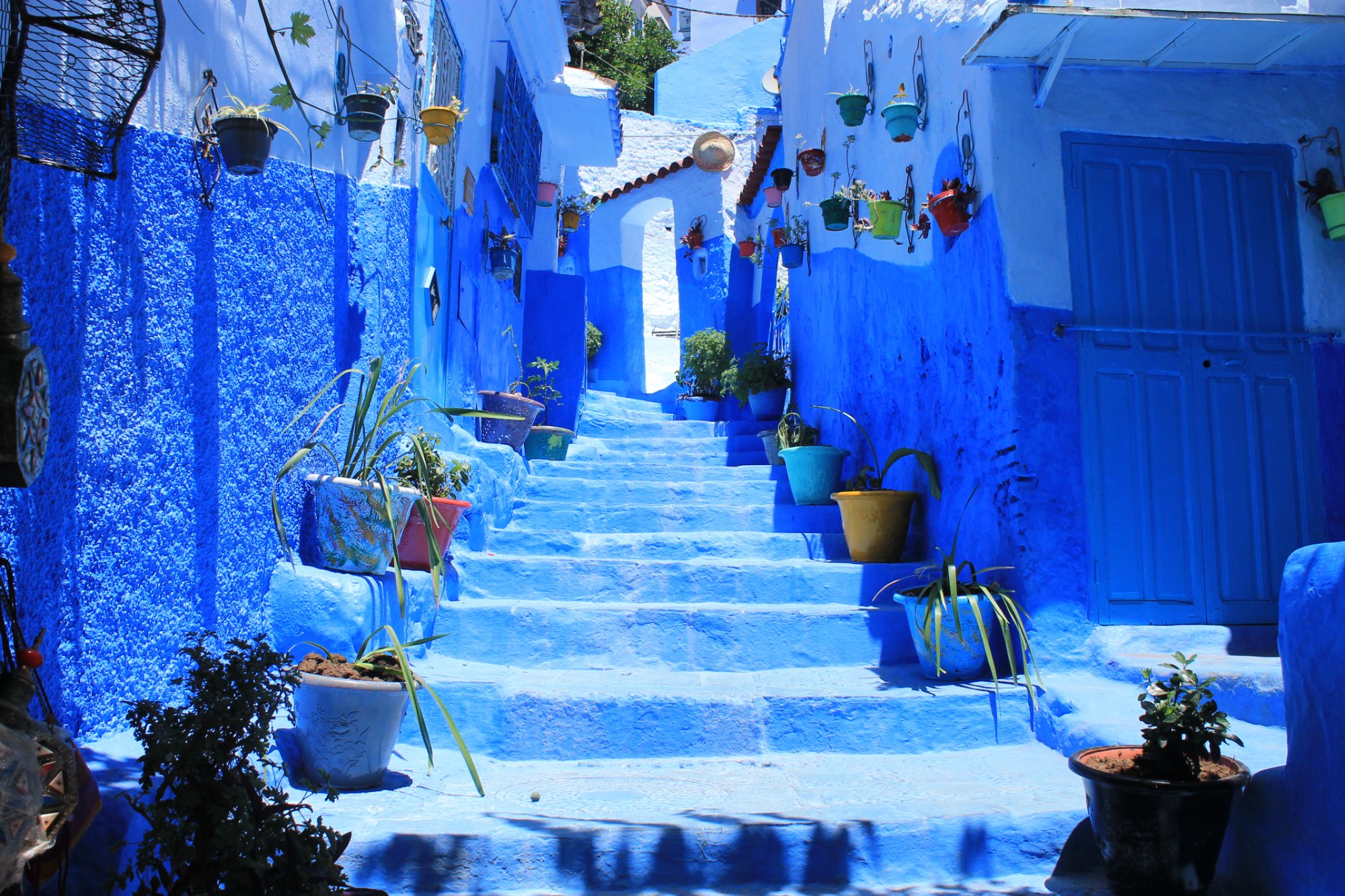
The next day's highlight was the blue city of Chefchaouen. Jodhpur, as I have heard from people who have been there (my wife), bears resemblance to this city. But I have never been to Jodhpur. I was awestruck by the beauty of the city. Every house was a similar cobalt blue. The reason being the color helps keep the houses cool from the desert heat. While Chefchaouen was in the proximity of the Sahara, Jodhpur is located near the Thar desert in Rajasthan. There are other theories as well: the most popular being a Jewish tradition from the 1930s which relates the blue color to the sky and heaven. After a sumptuous lunch with local dishes, accompanied by a generous serving of dates and olives, we had a cup of sugary mint tea, considered a national drink of Morocco. The other beverage of choice is an oily thick espresso enjoyed often with a cigarette. The country is yet to graduate from smoking. As for the oily espresso, I did not like it at all, and I still wonder how this could be so popular. Although, my wife begs to differ.
On our way to Fez, the cultural, intellectual and religious capital of the country, we made a brief stop at Rabat where the Atlantic and the Mediterranean meet each other, but do not mix. They bring their distinct shades of blue with them, and at Rabat, try to win each other over in their own oceany ways. At Fez, we had a day long tour of the old city. To set the context, most of the cities in Morocco has a walled Arab part of the city and a newer colonial part. Of course, this is not unique to Morocco. We saw a similar walled city in Colombia a few years later, but that story is for another day. The old city, because it is old, is a walking city, constructed at least a thousand years ago. The roads could only accommodate traditional hand-drawn carts or bullock carts at best. There were dark alleyways and brighter squares, blacksmiths with traditional tools repairing utensils, and the sound of azan coming from a nearby mosque. The highlight of the old city was the Medersas, an ancient school of Koranic studies, constructed not much later than the time when Islam started to spread across continents. The building had a picturesque courtyard and architecture that has its parallels in the Mughal buildings in India. We had our lunch in a restaurant within the old city itself — it was the house of a noble family converted to an eatery serving traditional delicious Moroccan fair. We ended our old city tour with a tannery visit, which was a questionable choice, especially after lunch!
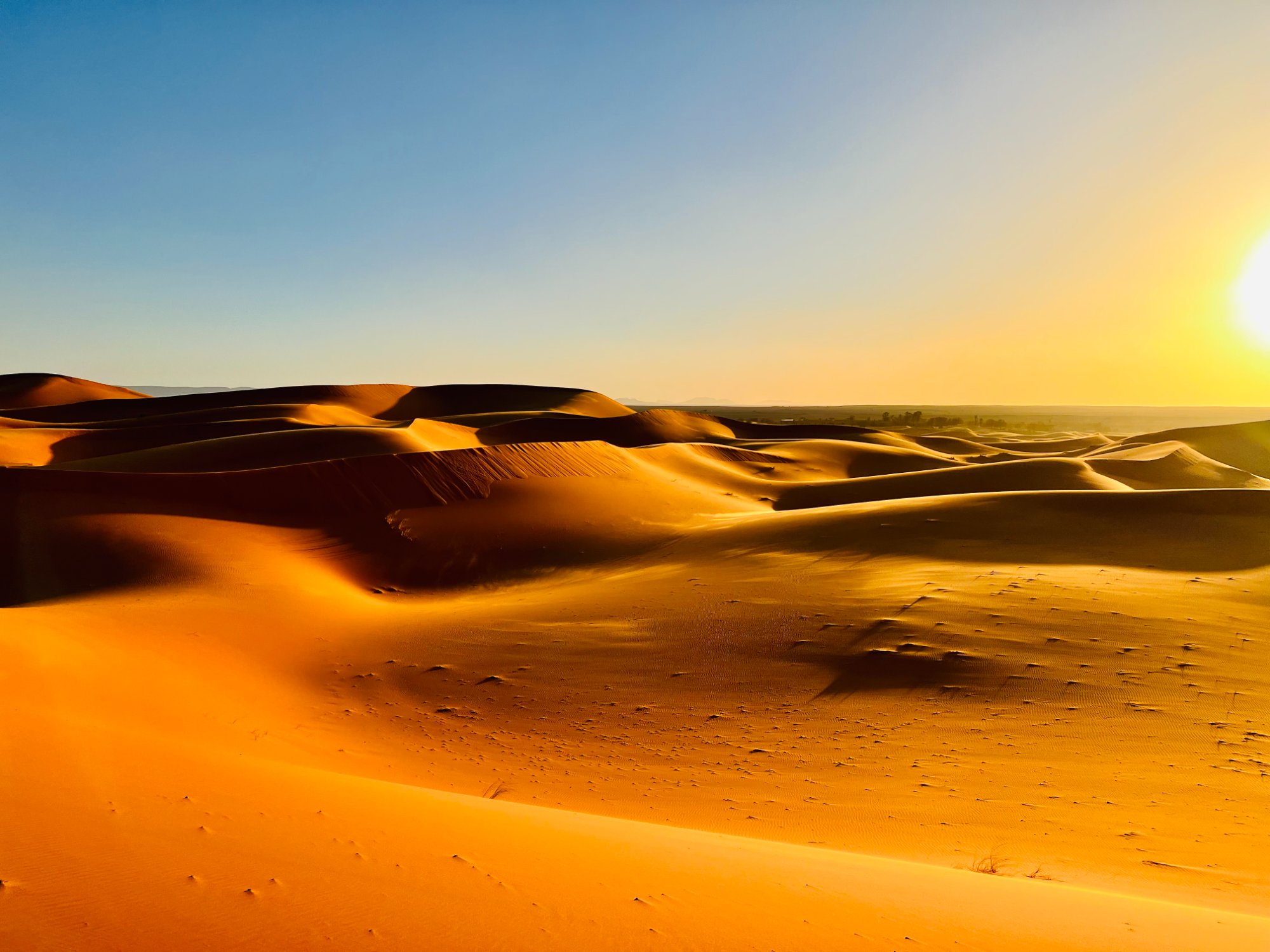
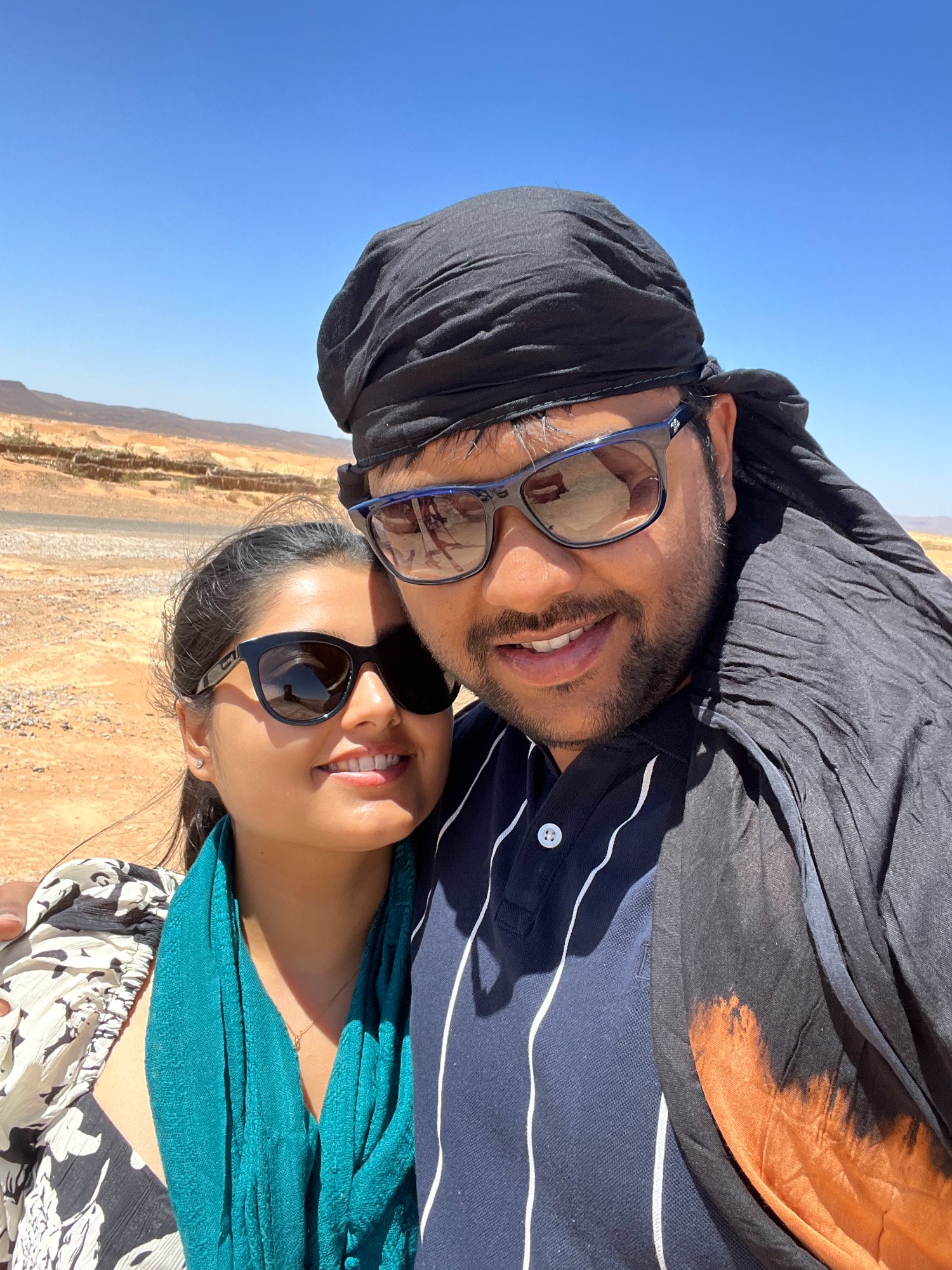
With Fez, we were moving inland already, away from the oceans. The temperature was climbing and the great Sahara was near. We were a bit worried about the heat and by then I had gotten a sunburn on my feet because of my uncovered open-toe slippers. It was time to look like an Arab as well. We bought scarfs to cover our heads, a bit later than we should have. The landscape had changed to rocky, barren, and dusty. However, there were vast stretches of palm and date trees, and oases in the desert. They provided cool shades to tired travelers in the past who would cross the desert to Timbuktu, an ancient market place located in present day Mali. We entered the desert on 4X4s and spotted milestones counting down the distance to Timbuktu from Erfoud, our entry-point to the great Sahara.
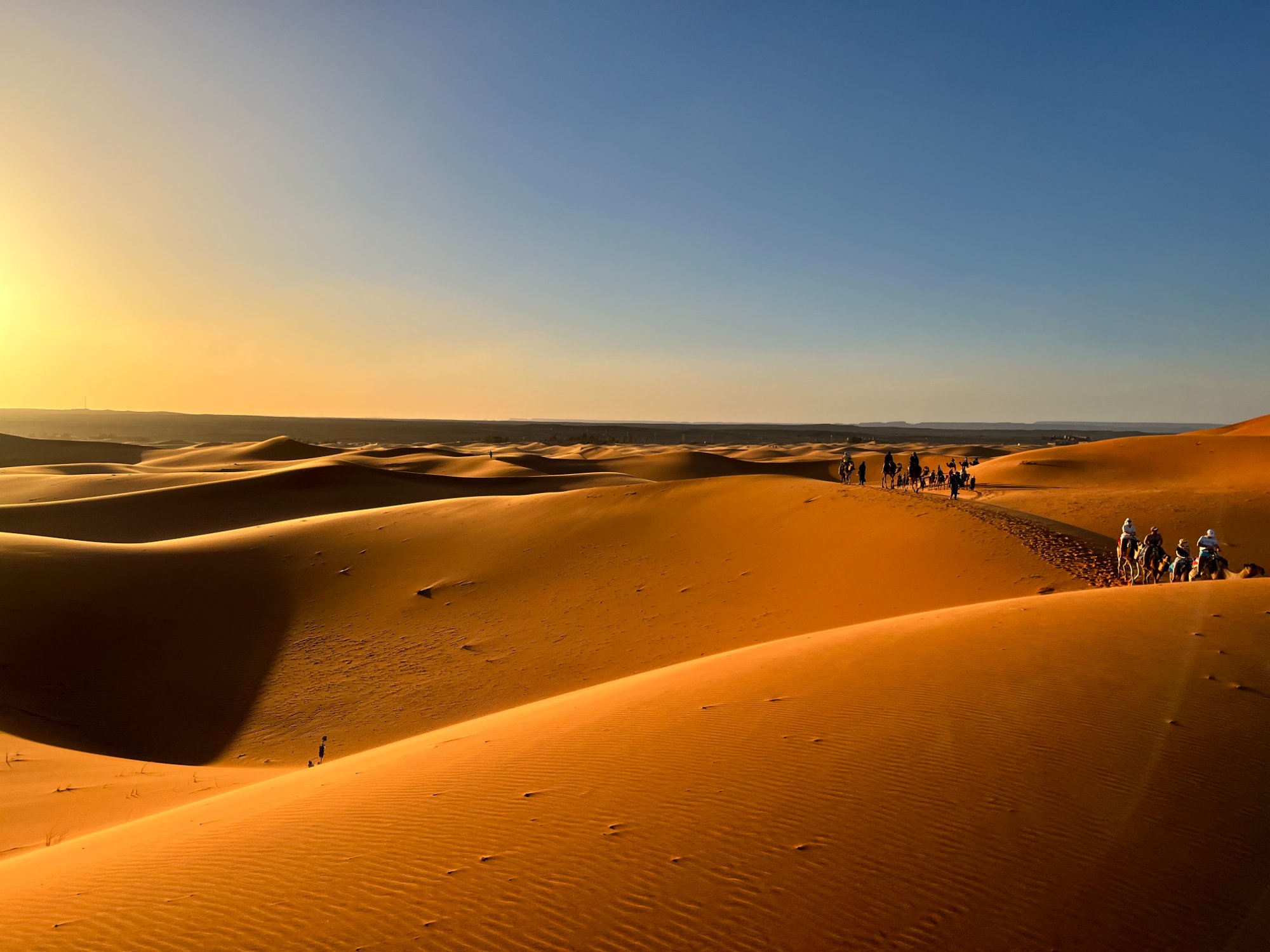
The Sahara is orange! It is nothing like I could ever imagine. The first sight of the dunes gave me goosebumps. We rode on camels to a sunset point. I was lucky to get an extremely well-behaved camel, unlike many of our co-travelers. We spent some time on the dunes experiencing the changing colors of the desert as the sun went down. We slept in tents that night and enjoyed local dance performance, and as usual, great food.
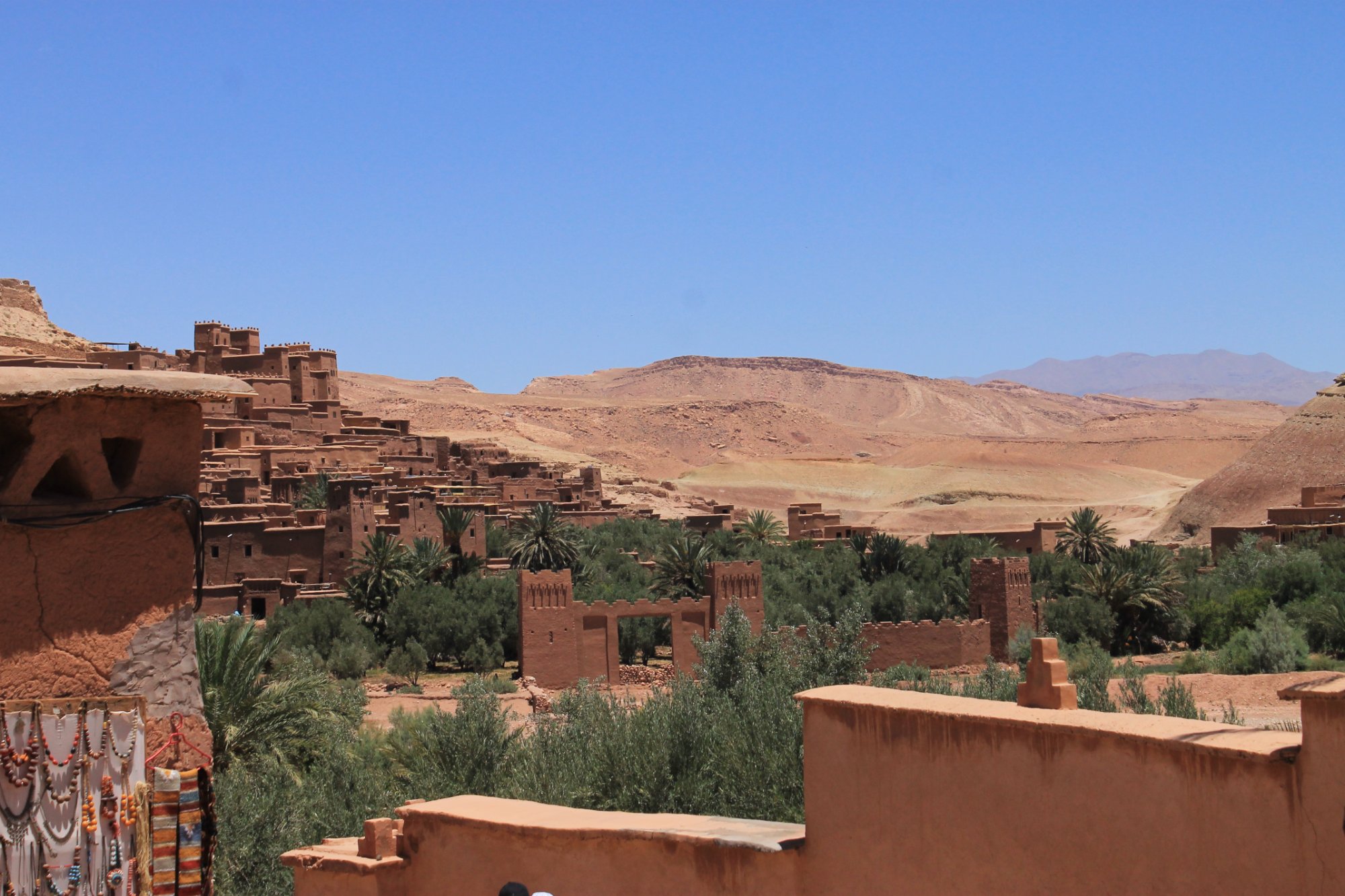
The rocky and dusty parts of Morocco had more to offer. Next, we visited the gorges of Todgha and Ait-Ben-Haddou. The latter was a fortification constructed before the 7th century AD. Historians are unsure about who might have constructed it, but modern Hollywood films have made full use of the landscape and the unique ancient structures of the place. The famous film, Gladiator, was shot at this location.
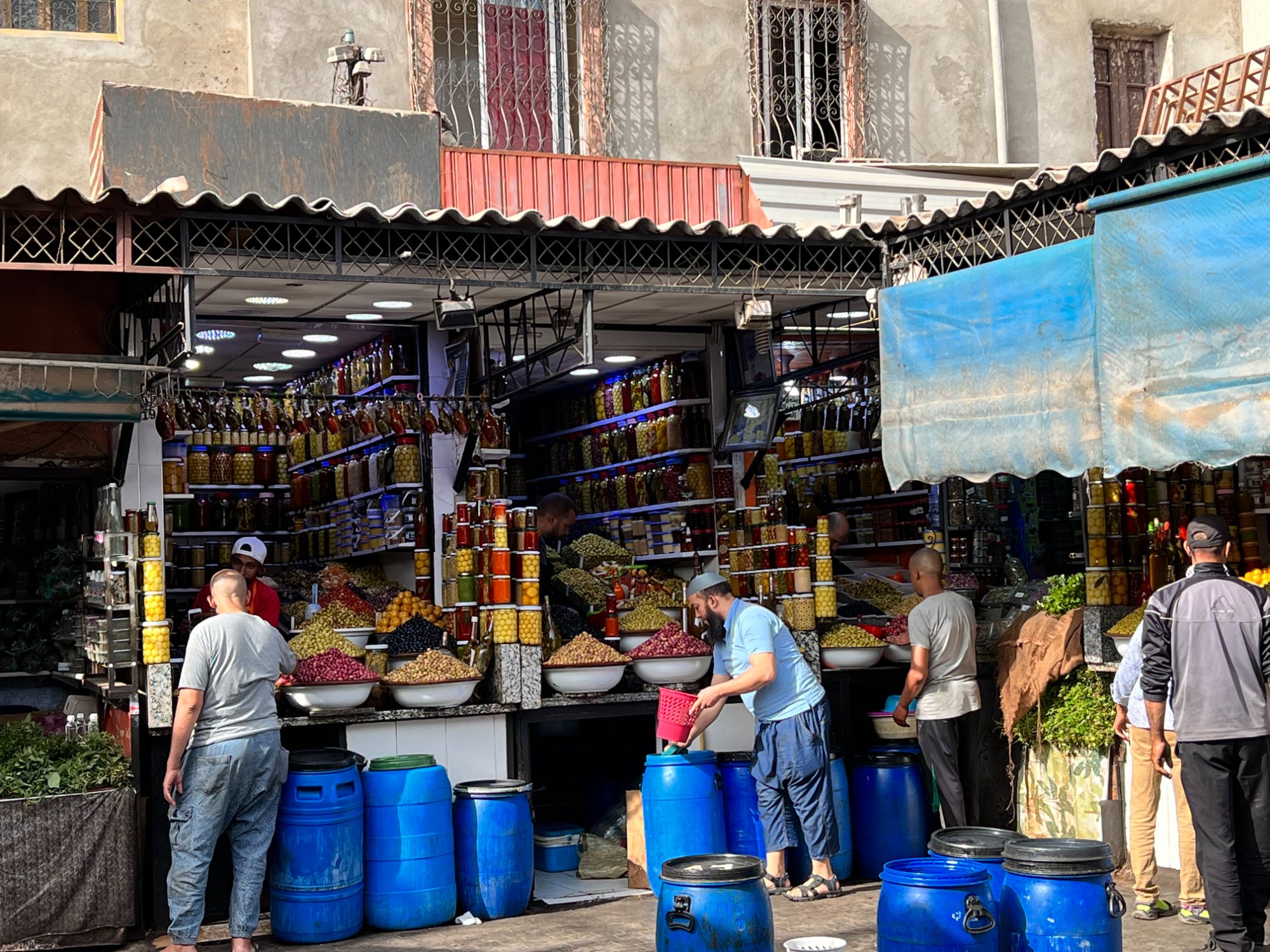
Our final destination was the city of Marrakech, full of colors, roadside cafes, and has a square that sells carpets and olives and hand-painted bowls, and so much more. We saw performances by snake-charmers, who immediately insisted for a tip, even though we showed no interest in their art form. By the way, tipping is a culture in Morocco. Even though most public services are free, tips are expected. They are sometimes also expected for services that are not free. Our guide Mohamed used to collect a small token amount every morning and paid the tips on our behalf. This was a relief!
Marrakech is where Devoja started our collection of hand-painted bowls, one from every country we visit. Our half-day city tour was converted to a full day bazaar adventure with Devoja bargaining with local traders, offering prices which, I am sure, were lower than the product's cost, and walking away in anticipation of a call back. My interventions were always met with a frown, sometimes even from the shopkeepers! Unable to keep up, I helped myself with some spicy green and red olives, and packed some for home. We bought a small blue and white geometric rug from this bazaar itself which adorn our Hyderabad bedroom, and brings back memories of that day, that souk, that smell, and that city!
We stayed at Hotel Palm Plaza, across the street from the La Mamounia hotel, where Winston Churchill used to stay during his visits. He famously loved Marrakech, calling it "the most lovely spot in the world" and a premier destination for his winter painting holidays starting in 1935.
One afternoon, when we were sitting in a cafe, after a long walk across town, we heard a local musician playing Hindi songs on a mandolin. We were surprised to know that Indian films were so popular in Morocco, to the extent that the movie theatres go full house when new Hindi movies make their way to town. The entire youth knows of Shah Rukh Khan, adores him, and imitates his character in popular films. Cinema has brought our civilizations closer, breaking barriers of language, geography, and culture.
We were already craving home; in my opinion, a signal of a trip well spent. It reenergizes you to get back to work with memories of joyous times. Also, by then, I had made up my mind to come back to Morocco again. A few weeks back I watched Lonely Planet, a Netflix movie featuring Laura Dern, and starting to coax my wife again.