Delimitation Math
Why was the Government of India (GoI) in such a hurry to redraw the electoral map of the country, so much so that it had to be bundled with an otherwise unrelated women's reservation bill? The freeze on the delimitation exercise that started in 1976 is set to expire in 2026, and was expected to be based on the first completed census after 2026.
Delimitation was coming regardless. The 2021 census was delayed and is taking place now, with an expected completion date of 2027. But, if the process is based on the 2027 census, the formation of an independent delimitation commission would take some more time and the process would surely not complete before the 2029 Lok Sabha elections. The government tried to leapfrog this and avoid the procedural delay. It proposed to increase the Lok Sabha seats to 850 from its current strength of 543, and base the distribution of seats by using the 2011 census. And to weaken the opposing voices, decided to bundle this with the long-pending operationalization of women's reservation.
Our constitution mandates the distribution of seats across states in proportion to their populations. For three arbitrarily chosen Indian states A, B and C, their ratios of seats to their population are expected to match, as much as practicable, by Article 81 of the constitution.
By this logic, the Southern states lose their proportion of representation in the Lok Sabha, and most of the states in the Hindi belt — Bihar, Uttar Pradesh, Madhya Pradesh — gain. While Tamil Nadu loses 1.3 percent and Kerala loses 1 percent of representation, Uttar Pradesh gains the most. The following set of maps show the numbers. The left panel is the percentage representation in the Lok Sabha with the current distribution of 543 seats. The right panel shows the percent loss (in red) and gain (in blue) in seat shares after a 2011 census based delimitation.
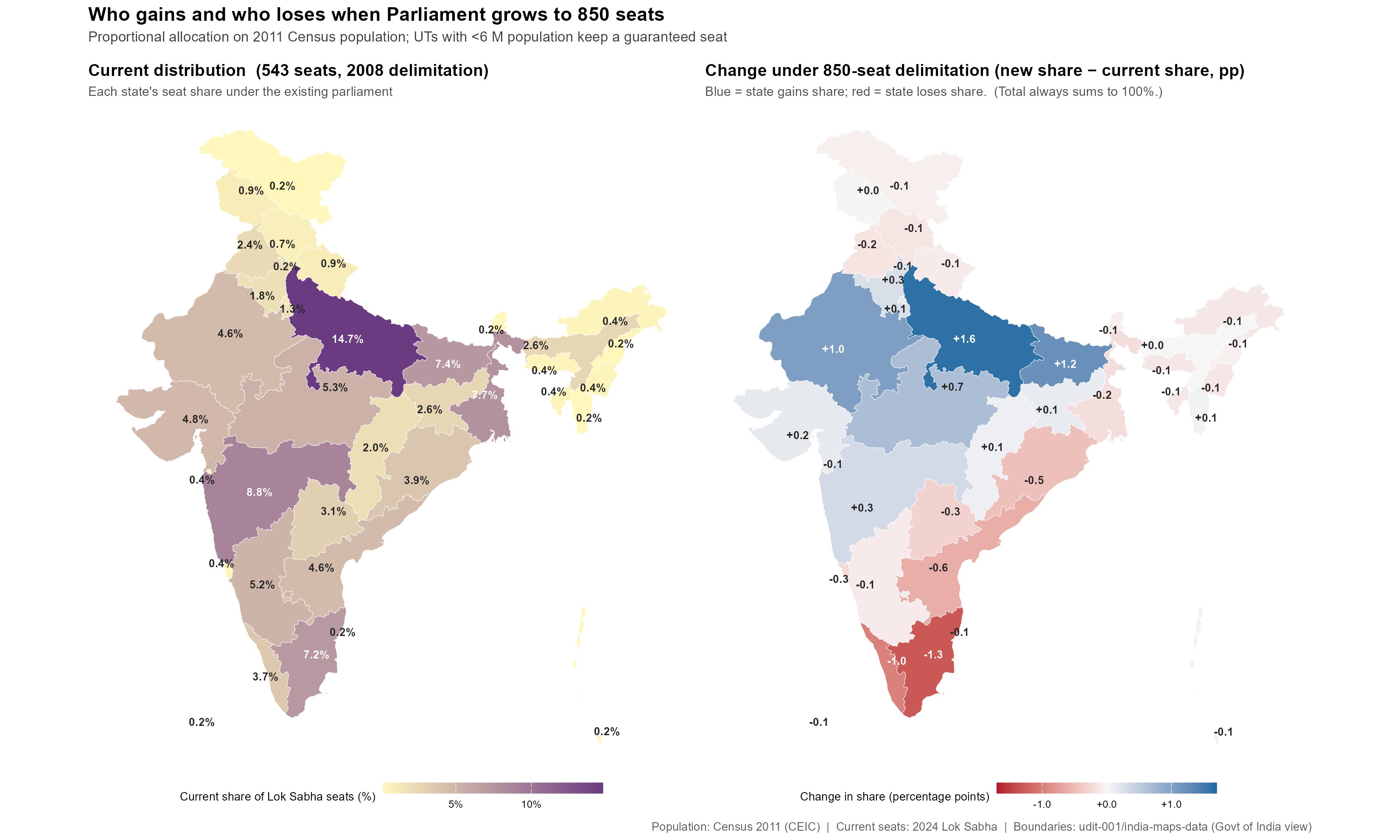
What is responsible for this northward shift of political power? The Southern states, including my adopted state of Telangana, have been above average in several human development indices, including the control of population. The states that gain have lagged behind, and have fertility rates above replacement levels. The newly proposed redistribution rewards these laggards. The rationale for the freeze in 1976 and 2001 was exactly to prevent this perverse incentive. The policymakers of the day argued that since populations in many states are yet to stabilize, a fresh delimitation would put brakes on the wheels of economic development. Are the populations stable enough today to lift the freeze?
This is also why the South vehemently opposes such redistribution. Since they have been bigger contributors to the nation's output, some of their proposals include formulae of redistribution based on GDP. However, they are likely to be unconstitutional. It violates the principle of one person, one vote, one value enshrined in our constitution.
What's in this for the BJP? The following set of maps partially answers this question. The map on the left panel shows the proportion of seats won by the BJP in the 2024 Lok Sabha elections. The saffron states are where the BJP won a majority of the seats. The Hindi belt contributed the most to the BJP's electoral success, although Uttar Pradesh was an electoral disappointment for the BJP. Keeping the seat-proportions won across states and UTs fixed, the map on the right panel shows the additional seats that the BJP could win if the currently proposed delimitation were to happen. While the party won 44.2% of the seats in 2024, a North biased delimitation, and similar electoral performance, would bring their seat share to 45.3%.
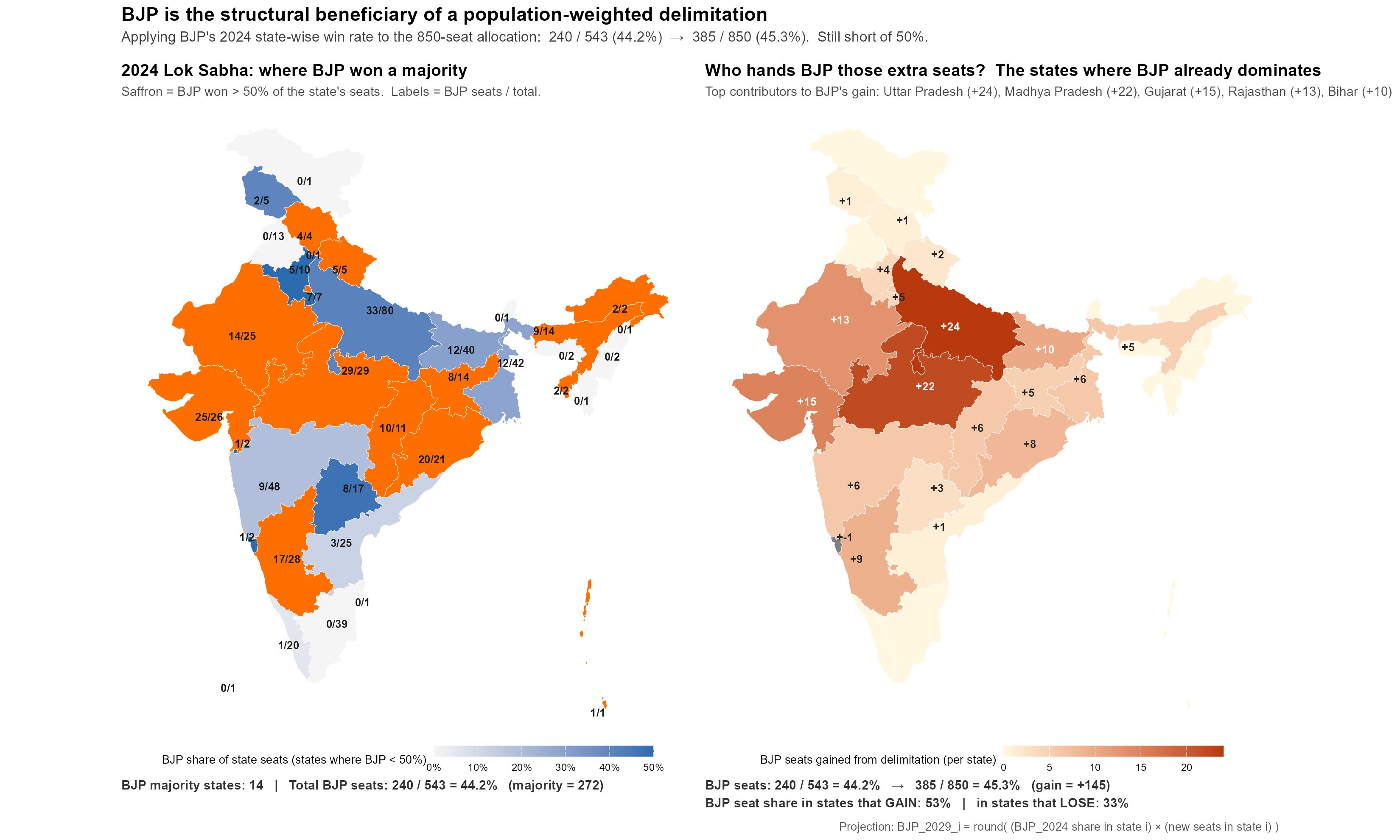
The answer is partial because the electoral gain is negligible. It would conclusively explain the rush if Uttar Pradesh — with its largest gain in terms of absolute as well as proportional numbers — were to flip in 2029 in favor of the BJP, and features somewhere in the ruling party's calculations.
If the 1.1 percent gain in electoral margin is too weak to explain the hurry, what does?
There are two possible explanations. The 2027 census will include a complete caste enumeration. An early delimitation, based on caste agnostic 2011 census, separates the two enormous exercises — caste based reservations and seat share rationalization — that would otherwise hit the agenda together. The other answer may be hiding in the way the electoral maps are likely to be redrawn; if the population has migrated or realigned in ways that may favorably impact the electoral math for the incumbent, making them act on it as early as possible.
What is the women's reservation bill doing amidst the dry math of delimitation? The government poses its operationalization (of an already passed 2023 bill) as a related exercise: the total seats expand to 850 and reserve 33 percent of them for women. Since the question of women's reservation enjoys unanimous support across party lines, the two unrelated topics were clubbed as one for ease of passage across the legislature. However, with the current set of bills blocked by the opposition, it is more likely that the 2029 elections will be fought on the current distribution of 543 seats. The cleanest test of the government's intent now is whether it operationalizes the women's reservation bill, without the delimitation rider attached. I choose to remain optimistic!